

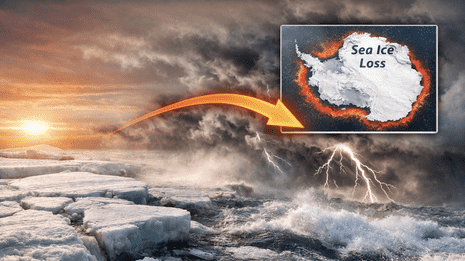
Following years of high sea-ice extent before 2015, Antarctic sea ice has declined rapidly. Scientists have observed record or near-record low seasonal sea-ice levels in several recent years. Researchers are now closely investigating the short-term weather patterns driving this rapid seasonal retreat.
A new study reveals that extreme sea-ice reduction events, typically lasting just two days, are an important factor. These brief episodes account for roughly 5% of a given sector’s total seasonal decline. Collectively, they contribute to about 41% of the total circumpolar seasonal retreat.
This extreme seasonal retreat occurs primarily from September to February, known as the austral warm season. The study notes this pattern is consistent with a possible regime shift after 2007. This shift coincides with more persistent season-to-season memory and spatial coherence of sea-ice anomalies.
The impact of these extreme reductions is becoming more pronounced over time. Researchers observed the lowest end-of-summer net sea-ice extent on record in 2017, 2022, and 2023. The annual maximum extent also dropped to a historic low in September 2023 after anomalously slow winter ice growth.
The Mechanics of Rapid Ice Loss
Researchers used advanced sea-ice budget analysis to isolate the exact mechanisms causing these sudden reductions. Thermodynamic melting dominates sea-ice reduction during these extreme events, while dynamic processes play a secondary role. This surface melting is closely linked to high heat flux anomalies.
During these extreme events, warm and moist atmospheric conditions drive a significant increase in sensible heat flux. Total column water vapor also increases, which sustains net longwave radiation over the ice. Together, these atmospheric factors play a major role in amplifying the regional surface heat flux.
This atmospheric combination creates favorable conditions for rapid thermodynamic melting at the surface. Wind dynamics also contribute to the changing landscape, though they do not drive the primary melting. High wind speeds dynamically advect the remaining sea ice directly toward the coastline.
This advection reduces ice cover at the outer edge while temporarily enhancing it along the coast. While dynamic shifts visibly alter the landscape, the overwhelming driver of total ice loss remains surface heat-driven melting.
Ocean waves also play a minor role during these turbulent weather periods. Large waves driven by coastal winds can fracture the sea ice and potentially enhance lateral melting. However, the study confirms that the rate of lateral melt is much lower than surface and basal melting.
Tracing the Tropical Connection
The study successfully traced the origins of some of these intense local weather conditions back to the tropics. In regions like the Ross-Amundsen and Weddell Seas, extreme reductions were associated with high-latitude blocking events. These large blocking systems are triggered by deep convection over the central tropical Pacific.
This distant tropical convection generates stationary Rossby waves across the global atmosphere. According to the study, the stationary Rossby waves activate anomalously strong blockings downstream of the sea-ice sectors. These systems actively direct warm, moist air intrusions from much lower latitudes into the polar region.
The blocking systems help transport heat and moisture poleward. Atmospheric rivers were associated with stronger moisture transport and conditions favorable for melting. The influx of warm air can accelerate thermodynamic melting at the surface.
The frequent occurrence of blockings downstream of the sea-ice edge during extreme reduction events is also conducive to the formation of atmospheric rivers. This highlights how interconnected weather patterns compound to deliver significant heat and moisture transport.
The Madden-Julian Oscillation also plays a distinct role in these atmospheric connections. Phases five through seven of this oscillation activate convection spanning the Maritime Continent and the Western Pacific. This specific atmospheric wave pattern strongly favors the occurrence of extreme reduction events in the Ross-Amundsen and Weddell Sea sectors.
Historical Precedents and Regional Anomalies
These weather patterns have driven significant historical melting events in the recent past. For instance, a record-deep cyclone triggered a 20% sea-ice extent decrease in the Weddell Sea sector in December 2016. That specific anomaly marked the fourth-largest three-day reduction on record for that month.
Similar extremes occurred when atmospheric rivers drove record-low daily sea-ice concentration anomalies in late 2016. More recently, the Ross Sea sector fell below its climatological mean following the largest November three-day retreat on record. This was caused by the passage of a deep cyclone in November 2021.
These extreme sea-ice retreats in the warm season amplify the ice-ocean albedo feedback. This critical feedback loop allows additional heating of the upper ocean. That absorbed heat further contributes to continued regional ice retreat in subsequent months.
Deep convection in the tropical Indian Ocean has also shown the capacity to trigger extreme polar events. Such convection sparked the strongest landfalling atmospheric river on record in East Antarctica. This specific event caused the unprecedented East Antarctic heatwave in March 2022.
While most events are relatively brief, the study identified ten distinct anomalies that persisted for more than ten days. These longer events extend well beyond the typical synoptic timescale. Each of these prolonged episodes contributed more than 13% of the total warm-season reduction within their specific sectors.
Future Projections and Climate Impact
The specific weather drivers vary significantly across different regions of the Antarctic coast. In the Indian Ocean sectors, extreme reduction events are primarily caused by anomalously strong extratropical cyclones. These deep cyclones are governed by internal mid-latitude wave activity rather than direct tropical forces.
The King Hakon VII and East Antarctic sectors experience shorter reduction events on average. In these regions, transient extratropical cyclones are more vigorous and fast-moving, limiting the duration of their impact on sea ice.
Despite regional differences, the overall impact remains a net loss of polar ice. While cold southerly airflows favor isolated sea-ice growth on the western flanks of certain sectors, the total Antarctic sea ice still exhibits an overall net reduction during these events.
The overarching findings indicate a potential shift in how the Antarctic environment responds to atmospheric conditions. Subsurface ocean warming since 2016 may be making the sea ice more vulnerable to these extreme weather events. This creates conditions that may favor rapid surface melt.
The global implications of this shifting climate state remain an active area of climate research. The study authors say abrupt changes in Antarctic sea ice behavior have implications for the global energy budget, atmospheric baroclinicity, and regional ice-shelf stability. Understanding these short-lived extreme events could improve Antarctic sea-ice forecasts and broader climate projections.