

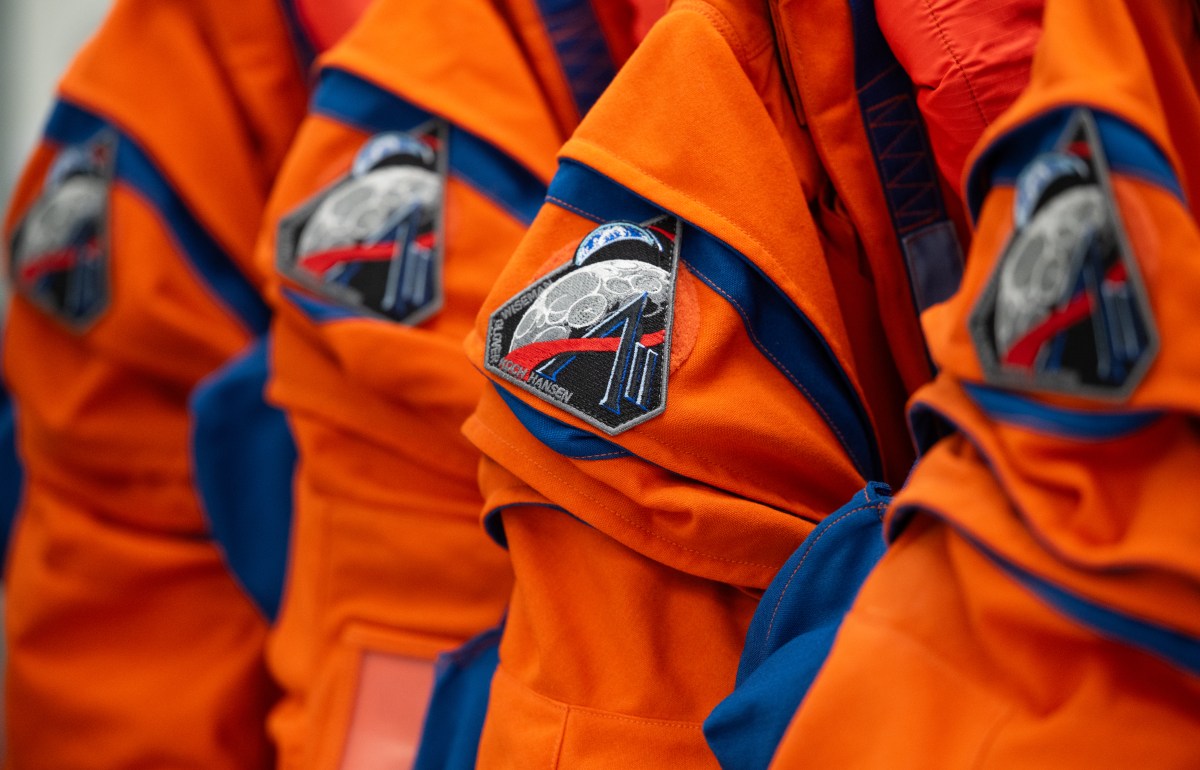
Up to 400,000 people are packing the beaches and causeways of Florida’s space coast today. Hotel rooms are in short supply as spring breakers and space enthusiasts flood the area. They are looking to the heavens to witness a fiery spectacle not seen in almost 54 years.
A fully crewed NASA rocket is scheduled to leave lower Earth orbit at 6:24 p.m. Eastern time. Launch director Charlie Blackwell-Thompson made the critical call to proceed with fueling operations at 7:33 a.m. EDT.
750,000 Gallons of Super-Chilled Propellant
Flight controllers are currently executing the “fast-fill” process for the core stage of the 322-foot Space Launch System. They are pumping super-cold liquid oxygen and liquid hydrogen into the massive orange first stage.
The rocket requires over 750,000 gallons of this highly volatile propellant to break free from Earth’s gravity. Because liquid hydrogen flows faster than liquid oxygen, the launch control team can load both propellants simultaneously and cut overall fueling time.
In the early morning hours, teams activated the automated ground launch sequencer. This system orchestrates thousands of commands in the final minutes before liftoff, managing precise valve movements and timing cues. Engineers also initiated an air-to-gaseous nitrogen changeover inside the rocket’s cavities.
This critical safety step displaces oxygen and moisture, creating a stable, non-reactive environment ahead of the heavy fueling.
Four Astronauts, Ten Days, and 685,000 Miles
The four astronauts assigned to Artemis II are scheduled to awake midday to prepare for their flight. They will not land on the lunar surface during this specific mission. This is a highly complex 10-day test flight designed to push the limits of deep space exploration.
Mission commander Reid Wiseman is a U.S. Navy veteran from Baltimore. He previously spent six months aboard the International Space Station in 2014, where he led two intensive spacewalks. Victor Glover sits in the pilot’s seat.
Glover spent six months on the ISS in 2020 and 2021, and will now become the first Black astronaut to travel around the moon.
Christina Koch made history in 2019 during NASA’s first all-female spacewalk. She will now make history as the first woman to fly on a lunar mission. Canadian Space Agency astronaut Jeremy Hansen completes the crew.
Hansen will become the first non-American to leave Earth orbit. He has completed simulated space missions in harsh environments, but this will be his first actual trip to space.
Collectively, this crew will fly farther from Earth than any human being before them. By flight day six, they are expected to reach more than 4,600 miles beyond the far side of the moon.
This trajectory will place them just short of 253,000 miles from home. It will officially break the April 1970 distance record set by the ill-fated Apollo 13 mission.
Surviving Inside a 5-Meter Micro-Camper
The journey requires living inside the Orion space capsule for ten consecutive days. The capsule measures just five meters in diameter. It offers an interior volume roughly the size of a small camper van.
“Like clicking a pen cap can annoy somebody over 10 days in a small capsule,” Wiseman told reporters. He acknowledged the tight quarters will test their patience by day six or seven — but said the crew has maintained an honest dialogue throughout training.
During this time, their health will be monitored at every stage. This includes a thorough study of the physical effects of increased radiation and microgravity. They will share this confined space until their eventual splashdown in the Pacific Ocean after a 685,000-mile odyssey.
A key part of this lunar flyby is to photograph areas of the moon’s south pole from a height of 4,000 to 6,000 miles. This visual data will help scout locations for the next human landing and eventual lunar base. The long journey also allows the astronauts to test crucial life-support systems needed for Artemis IV, the crewed mission scheduled for 2028 that plans to place human footprints back on the lunar surface.
The Razor’s Edge of Weather Constraints
Before anyone leaves the launchpad, nature must cooperate. NASA weather officers with the U.S. Space Force are monitoring conditions constantly, currently reporting an 80% chance of favorable weather.
Tanking operations cannot even initiate if the 24-hour average temperature drops below 41.4 degrees Fahrenheit. Conversely, NASA will abort the launch entirely if temperatures exceed 94.5 degrees Fahrenheit for 30 consecutive minutes.
Wind is another critical threat. NASA will not launch if peak liftoff winds hit between 29 and 39 knots at specified altitudes.
Lightning presents an immediate hard stop. A launch is scrubbed for 30 minutes if a single lightning strike is observed within 10 nautical miles of the flight path. NASA also enforces strict rules regarding cloud cover.
The agency will not launch if the flight path comes within 3 nautical miles of a thunderstorm debris cloud for three hours.
Even space weather plays a major role. NASA will not launch during severe or extreme solar activity. An increased density of solar energetic particles has the potential to permanently damage electronic circuits and sever radio communication with the vehicle.
The Final Countdown at Pad 39B
Earlier today, engineers finished critical health checks on the rocket’s four RS-25 engines, confirming that sensors, connections, and diagnostics were performing as expected. Teams also brought the Orion spacecraft’s flight batteries to full charge to ensure dependable power for avionics and life support.
Inside the capsule, engineers performed regulator leak checks on the astronauts’ pressure suits to verify airtight seals in the unlikely event of cabin depressurization. Tonight, all non-essential personnel will depart Launch Complex 39B.
This clears the immediate area of everyone except the specialists required for the dangerous cryogenic loading tasks.
The mission serves as a foundation stone for a planned $20 billion moon base by the end of the decade. NASA administrator Jared Isaacman emphasized that when America returns to the moon, they are there to stay.
But the astronauts themselves are looking beyond their own historical milestones.
“We want to quickly be forgotten, so that you interview the next crews,” Glover said.