

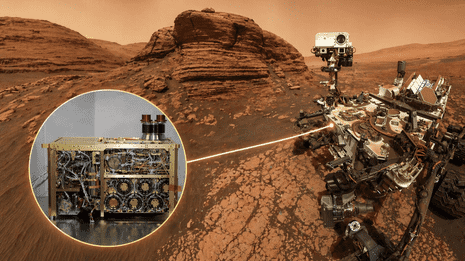
NASA’s Curiosity rover has successfully extracted seven confirmed and more than 20 additional tentative organic molecules from a 3.5-billion-year-old rock in Gale Crater. Researchers emphasize these molecules do not automatically indicate past life, as their exact origin remains unknown.
The discovery marks the first time a tetramethylammonium hydroxide (TMAH) wet chemistry experiment was executed in situ on another planetary body. The analysis utilized the rover’s Sample Analysis at Mars (SAM) instrument suite to test a clay-bearing sandstone.
The sample was drilled from the Mary Anning 3 target within the Knockfarrill Hill member of the Glen Torridon region. The surrounding strata consist of ancient lacustrine facies and fluvial environments. The mineralogy is dominated primarily by dioctahedral smectites, which are expected to present an optimal environment for concentrating and preserving organic matter.
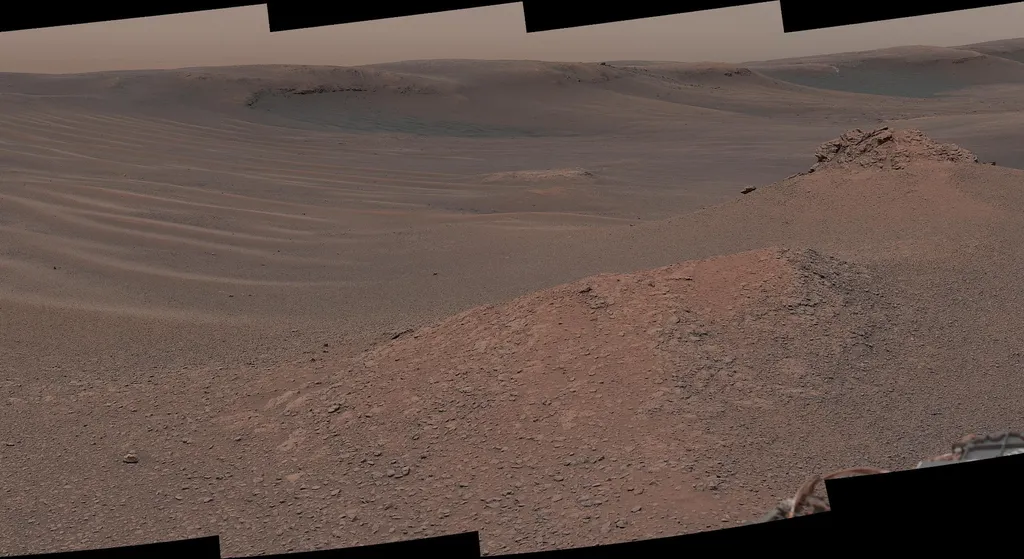
The lower strata of Aeolis Mons record environments impacted by a variety of diagenetic regimes. The transition from the underlying Jura member to the Knockfarrill Hill member indicates a shift from low-energy mudstones to a nearer-shoreline, fluvial-influenced environment.
Previous reports of Martian organics in Gale crater included chlorobenzene and dichloroalkanes detected in the Sheepbed mudstone. This specific wet chemistry experiment was designed to break apart large macromolecular structures and release organic compounds that standard pyrolysis alone cannot access.
Chemical Extraction on Mars
Curiosity utilized a feed-extended sample transfer approach to deliver approximately 163 milligrams of drilled fines into the SAM instrument. The sample soaked in a chemical reagent comprising 25 percent TMAH in methanol.
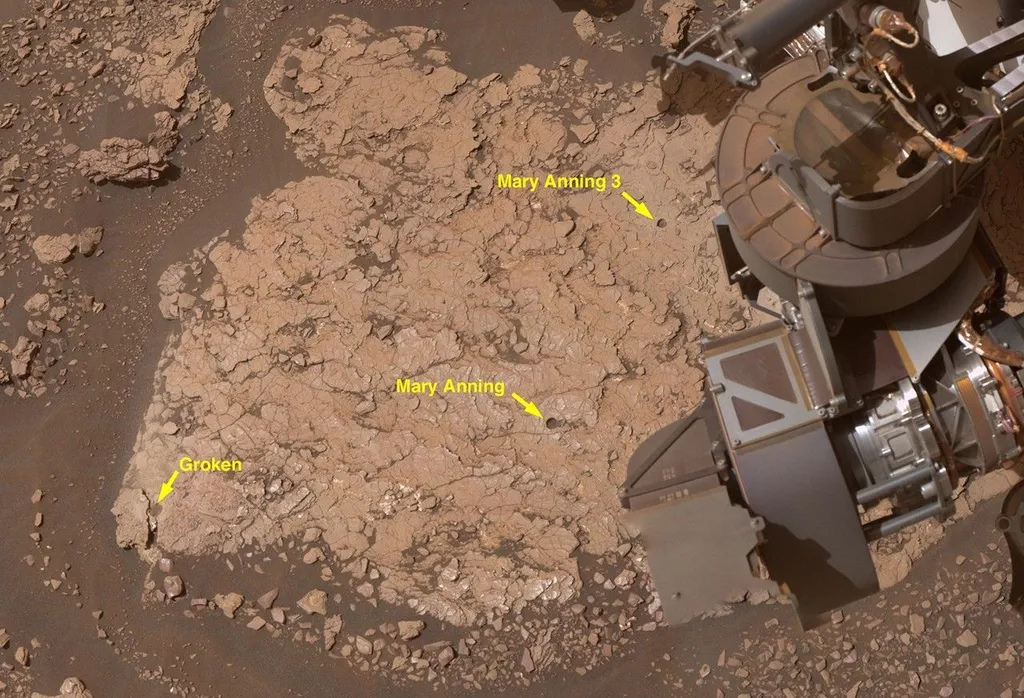
The SAM instrument then heated the targeted sample up to a maximum of 550 degrees Celsius. The thermochemolysis process hydrolyzed the sample organics, releasing organic fragments from ancient macromolecular materials as volatile gases.
During the initial heating phase, an evolved gas analysis system continuously measured the bulk gas composition directly. The analysis revealed high-molecular-weight molecules with specific mass-to-charge ratios reaching up to 537.
Simultaneously, a portion of the evolved gas was routed toward the gas chromatograph-mass spectrometer. These gases were periodically subsampled and captured on a dedicated hydrocarbon trap. Trapped analytes were subsequently heated and released into the specialized gas chromatograph columns for precise molecular identification.
Aromatic and Sulfur-Bearing Findings
The chemical extraction identified specific thermochemolysis products. The confirmed molecules include trimethylbenzene, tetramethylbenzene, naphthalene, methyl benzoate, and dihydronaphthalene. The data also confirmed the presence of benzothiophene, a sulfur-bearing molecule.
Researchers described benzothiophene as the largest confirmed underivatized aromatic molecule identified as indigenous to Mars so far. No known pyrolysis or thermochemolysis process on the SAM instrument generates benzothiophene as an internal byproduct. The findings suggest the molecule was liberated directly from an indigenous Martian macromolecular source.
Calculated molecular abundances from the experiment ranged from 0.1 to 1.7 nanomoles. The detection of methyl benzoate confirmed that the TMAH reagent successfully reacted with the Martian sample to generate a carboxylic acid methyl ester.
Previous laboratory tests indicated methyl benzoate could form through reactions with calcium perchlorate. However, perchlorates were not detected in the Mary Anning target, ruling out that specific origin pathway.
Instrument Limitations
The experiment faced instrument limitations during the analysis. A gas chromatograph column intended for the operation clogged during an earlier test on the rover. This forced the mission team to commission a different column that did not utilize an injection trap.
Furthermore, a nonanoic acid internal standard was lost due to the specific sampling cadence. The instrument valves required venting gases to prevent the highly alkaline TMAH decomposition byproducts from overwhelming the hydrocarbon trap. To mitigate trap saturation, operators kept the hydrocarbon trap at 85 degrees Celsius, allowing the bulk of the unreacted TMAH to pass through.
Meteorite Comparisons and Caveats
To understand where these organics came from, researchers compared the Martian data with laboratory experiments on the Murchison meteorite, a well-studied carbonaceous chondrite. They found that 16 of the 28 species confirmed or tentatively identified in the SAM experiment were also present in the TMAH thermochemolysis of the meteorite.
The analysis initially indicated the presence of a molecule with mass spectra matching dimethyl-indole, a nitrogen-heterocycle. Researchers did not conclusively identify it as dimethyl-indole because laboratory retention time experiments showed a 3.7-minute offset relative to the candidate molecule. They instead suggest the molecule consists of a methylated dicyclic aromatic with an N-heterocycle.
The chromatograph data also revealed potential nitrogen-bearing molecules across several specific peaks, including signatures pointing to amine functional groups. The researchers also detected oxygen-bearing molecules comparable to those identified in benchtop tests of the Murchison meteorite. These similarities point toward the partial methylation of meteoritic macromolecular carbon.
The experiment did not detect aliphatic carboxylic acid methyl esters, a class of molecules commonly liberated from carbonaceous meteorites. Researchers noted this absence is likely due to the specific flight operating conditions rather than a complete lack of the compounds on Mars.
Future Missions and Astrobiology
The detection of these molecules means researchers must now address whether these compounds are exogenous, arriving via meteoritic or cometary impacts, or endogenous, produced by the planet itself. The SAM instrument cannot analyze the spatial distribution of the organics, leaving this core question unanswered.
The successful detection of these cyclic and aromatic molecules demonstrates that chemical diversity is preserved in ancient Martian surface materials despite 3.5 billion years of diagenesis and radiation exposure. These specific findings are expected to inform upcoming thermochemolysis experiments planned for the Rosalind Franklin Mars rover and NASA’s Dragonfly mission to Saturn’s moon Titan.
The confirmation of macromolecular organic matter supports the possibility that future optimized TMAH experiments can liberate ancient biosignatures, if they are present on Mars.