

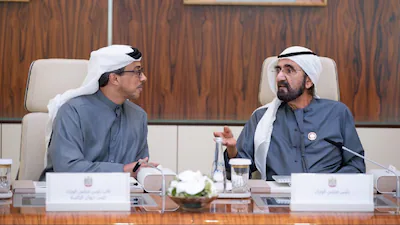
The United Arab Emirates cabinet has approved a framework to integrate agentic artificial intelligence into government operations and advanced major sustainability initiatives.
The United Arab Emirates will deploy agentic artificial intelligence across 50 percent of its government sectors and operations within two years. The framework, announced Thursday, April 23 by Mohammed bin Rashid, follows directives from the UAE President and was described by the UAE’s National Media Office as a global first.
Agentic AI differs from standard generative models by operating autonomously to execute complex, multi-step tasks without constant human prompting. Integrating this technology into federal operations represents a significant shift in how administrative and public services will function across the region.
The transition toward autonomous systems builds upon the country’s established digital governance strategy. According to historical UAE government data, the nation appointed the world’s first Minister of State for Artificial Intelligence in 2017 and has consistently funded large-scale digital transformation projects.
Representatives from the Mohamed bin Zayed University of Artificial Intelligence (MBZUAI) were not immediately available for comment. A request was made regarding the logistical and infrastructure requirements necessary to scale agentic systems across half of all government sectors within the 24-month timeframe.
Financial leadership restructuring
The AI policy announcement arrived alongside major restructuring within the country’s financial leadership. The cabinet approved the reconstitution of the Board of the Emirates Development Bank, which will now be chaired by Dr. Sultan bin Ahmed Al Jaber to oversee future fiscal strategies.
The newly formed board consolidates leadership from various economic sectors. Members include Minister of Economy and Tourism Abdulla bin Touq Al Marri and Ahmed Tamim Al Kuttab, Chairman of the Department of Government Enablement in Abu Dhabi.
Other appointed members include Ministry of Finance Under-Secretary Younis Haji Al Khoori and Hassan Jassim Al Nowais, Under-Secretary at the Ministry of Industry and Advanced Technology. Mohamed Saif Al Suwaidi of the Abu Dhabi Fund for Development will also join the leadership group.
Abdulwahed Al Fahim of Nasdaq Dubai, Najla Al Midfa of the Sharjah Entrepreneurship Center, and Khalfan Belhoul of the Dubai Future Foundation complete the board. Mariam Saeed Ghobash, Director of International Affairs at Abu Dhabi Investment Company, was also appointed.
Biofuel expansion and energy efficiency
The cabinet reviewed progress on the National Biofuel Policy 2025, a core component of the country’s sustainability strategy. Officials detailed projects designed to convert approximately 500,000 tonnes of waste into sustainable aviation fuel.
Sustainable aviation fuel (SAF) is viewed by the global aviation industry as a primary mechanism for reducing carbon emissions. Producing SAF from municipal waste provides a dual benefit by managing local refuse while creating lower-emission alternatives to traditional jet fuel.
The waste-to-fuel initiative includes a biodiesel plant with a planned annual production capacity of 20 million liters. Additionally, the government outlined a new facility in Fujairah requiring an estimated investment of $300 million to further support alternative energy production.
The Abu Dhabi-based International Renewable Energy Agency (IRENA) was not immediately reached for independent comment. Requests focused on the regional processing infrastructure required to meet these new aviation fuel conversion targets.
To further support these environmental targets, the UAE launched a global alliance for energy efficiency. The international initiative is intended to accelerate climate action and support sustainable development goals across participating nations.
The cabinet also approved a national plan for ivory and rhinoceros conservation to protect biodiversity. During the same session, officials ratified the Federal Final Accounts for 2025, which provide the fiscal baseline for federal initiatives.
International treaties and upcoming events
The cabinet also broadened its international commitments, authorizing the UAE’s accession to the International Accreditation Organization. This agreement is designed to strengthen alignment with global standards, enhance the recognition of national certifications, and support international trade networks.
Looking ahead, the government confirmed the UAE will host several major global events, including World Mathematics Day in 2026. The country is also preparing to hold global conferences focused on biodiversity, food security, and the digital economy.
The UAE has positioned both the global events calendar and the two-year AI rollout as instruments for building long-term influence in digital governance and international policy.